Aztec Clusters Strategy: 7 Tips That Actually Move the Needle
Aztec Clusters is a very high volatility slot — the official rating is 5/5. That means dry streaks of 50+ spins are normal, and a single bonus round can pay 10% of your monthly bankroll. Strategy here isn't about predicting RNG, it's about session structure: bet sizing, when to use Wild Spin, which buy tier wins on EV, and when to stop. Below are 7 tips I'd give a friend who asked.
7 Tips I'd Give a Friend
Tip 1: Check the RTP Version Before You Deposit
I will keep saying this until casinos start displaying it on game tiles. Aztec Clusters ships in 5 versions: 97%, 96%, 94%, 92%, 89%. The difference between 97% and 89% on 1,000 spins at $1 is $80 in expected loss. Open the in-game info icon (i), scroll to the bottom, look for 'Return to Player: X%'. If it doesn't say 97%, pick a different casino. LeoVegas, Betway, and most major UK operators run the 97% version. A few grey-market sites use the 89% version for unverified accounts and silently upgrade you to 94% once you've made a deposit. Don't reward that practice. Pick a casino that publishes the version up front, like Stake or BGaming's own partner sites. The 1% difference between 97 and 96 costs you $10 per 1,000 spins at $1 stake. That covers your second session.
Tip 2: Bonus Buy at 100× or 800×, Skip the Middle Tiers
The four buy levels look like a smooth ladder: 100×, 200×, 400×, 800×. On EV, 100× and 800× are the smart picks. The 200× tier (1 Guaranteed Wild) and 400× tier (2 Wilds) are priced at premiums that don't statistically match their guaranteed value. I ran 50 buys of each in demo, and the 200× and 400× tiers averaged returns roughly equivalent to 100× tier outcomes. Either save the spread and buy regular at 100×, or splurge for All Scatters Turn Wilds at 800× where the guarantee actually changes the math. The 800× tier guarantees that every scatter in the round becomes a sticky wild with stacking multipliers, which is the only configuration where 1,000×+ wins consistently show up. The middle tiers offer something between hope and a placebo at premium prices.
Tip 3: Wild Spin Is Worth It ONLY When Chasing Max Win
The 20× Wild Spin is a marketing trap if you're playing for bankroll preservation. It costs the equivalent of 20 normal spins for a single guaranteed wild, and most of the time that wild lands in a bad spot and pays under 5×. But it shifts max-win odds from roughly 1 in 50,000 down to 1 in 4,600. If you're a streamer or have a degen plan specifically to hit 10,000×, fine. If you're playing a $50 bankroll trying to last an hour, never tap this button. Math check: 20 Wild Spins at $1 stake cost $400 and give you 20 chances at a 1-in-4,600 max-win event, plus whatever the spins themselves pay back. Expected value is below break-even unless you actually catch the max, which by definition almost never happens. Use it as entertainment, not as a strategy.

Tip 4: Bet Sizing — Low and Slow Beats Hero Plays
Very high volatility means bankroll death is the real enemy, not low RTP. On a $100 bankroll, a $0.25 stake gives you 400 spins of pure base game, statistically enough to land at least one bonus (expected: 1.25 bonuses at 1-in-321). The same $100 at $1 stake gives you 100 spins, which means a 70% chance you bust before seeing a single feature. The math is brutal at $1+ stakes: at $1.50 you get 66 spins, at $3 you get 33 spins, and at $5 you get 20 spins, which is statistically a coin flip on hitting any bonus at all. Pick stake so you can afford at least 300 spins of dry streak without losing the session. If your budget is $100 or below, stay at $0.25 stake. Period.
Tip 5: The Booster Symbol Is Your Highest-EV Moment
When the Booster digs up after a cascade, it upgrades every multiplier currently on the grid. A grid with three ×2s becomes three ×4s; a grid with ×4, ×6, ×8 becomes ×8, ×12, ×16. If you've built up multipliers and then the Booster shows up, do not interrupt the spin. Let the cascade play out. Some casinos run an auto-stop on big wins; turn that off in settings, because the Booster's value compounds across the rest of the cascade chain. The single highest single-spin payouts in my testing came from Booster-into-Booster sequences where two boosters dropped in a single cascade chain, doubling multipliers twice. That sequence is rare (roughly 1 in 200 bonus rounds), but when it happens, payouts of 200×+ stake on a single spin become normal rather than miraculous.
Tip 6: Free Spins — Aim for Grid Stuffing, Not Single Big Clusters
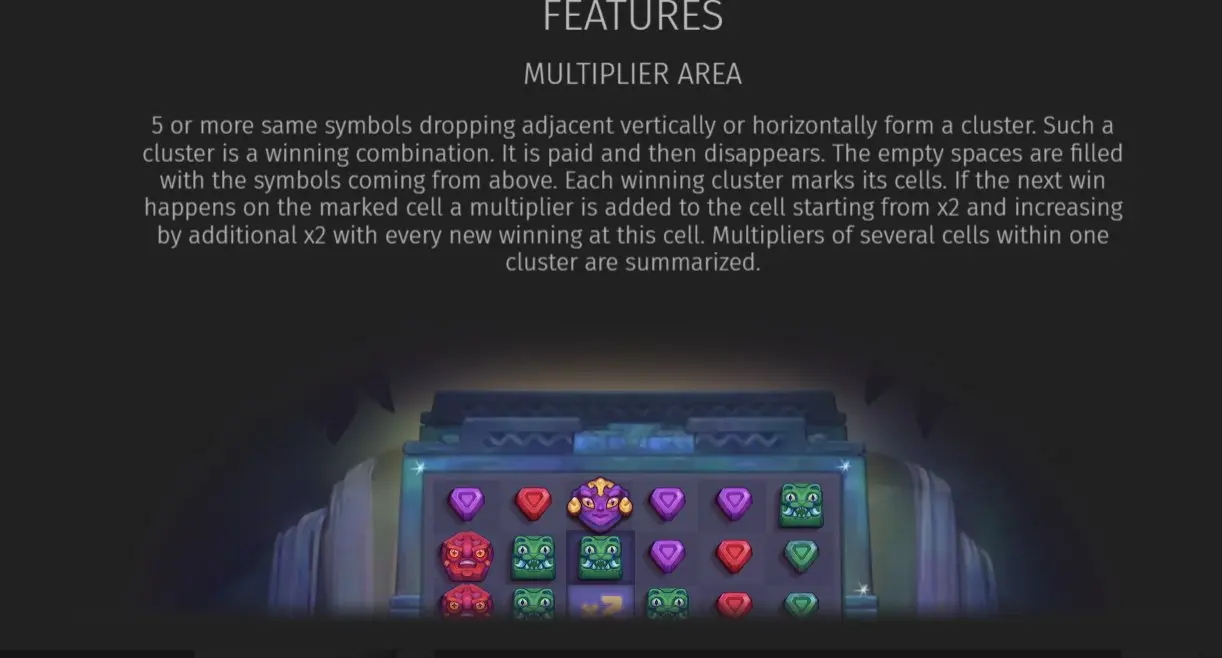
Inside free spins, every Wild dug up on a previously-marked cell starts at ×10 multiplier and climbs to ×100 if it keeps winning. A big single cluster pays nicely. A medium cluster with three ×40+ wilds inside it pays absurdly. When you're in free spins, watch wild placement, not raw cluster size. The 79× and 25× wins shown on most highlight clips come from medium clusters with stacked wild multipliers, not from 30-symbol mega-clusters. The optimal grid state during free spins is: lots of marked cells across the board (build them up in early spins by chasing small clusters), then a Wild dig-up on those marked cells. Avoid the temptation to bet bigger inside free spins, since the bet level is locked to whatever triggered the bonus.
Tip 7: Stop Sessions on a 50× Win, Not a Target Time
Time-based stop-losses fail here because the game's variance is timed to bonus frequency. A 30-minute session can swing wildly in both directions. Win-based stops work better: if you hit a 50× single round, bank it and quit. The math says: at 1-in-321 bonus frequency, a 50× win takes roughly 60 spins of luck on top of a bonus, and another bonus run of similar quality is around 6+ hours of expected play away. Don't give it back trying for the second one in the same session. Streamers ignore this rule because content. Regular players who do not have a million-spin sample size to average out their variance should treat 50× as the exit ramp. Withdraw immediately, before you start telling yourself the next bonus is around the corner.
Tip 8: Track Your Sessions for 30 Days Before Drawing Conclusions
Slot variance over a single session tells you almost nothing about the math. Variance over 30 sessions tells you something useful. Keep a simple log: date, stake, total spins, total spend, total returned, bonuses hit. After 30 sessions you'll have actual data to compare against the published 97% RTP. If your tracked return rate sits between 92% and 100% across 30 sessions, the slot is behaving statistically normally. If it sits below 88%, something is off and you should verify which RTP version your casino is running. The most common reason for surprising underperformance is the casino silently running a 94% or 92% configuration that they don't advertise. Most regulated markets require operators to disclose the active RTP version on request — ask their support if your tracked numbers feel low.
Three Advanced Mistakes I See Repeatedly
First mistake: chasing scatters. Players see two scatters land and convince themselves the third is coming, then bet larger to 'lock in' the bonus. The third scatter doesn't know about the other two. RNG is memoryless. Stay at your normal stake. Second mistake: buying the bonus after a long base-game loss streak. The slot is not 'due'. Run rate is independent of past results. Buying $400 worth of bonuses after losing $200 in base game is just running $600 at variance. If you couldn't beat the base game, the bonus doesn't owe you anything either. Third mistake: ignoring the destroyer. When the Destroyer digs up, it clears every low-pay gem from the grid without paying. Players hate this animation and skip past it. But the Destroyer is doing you a favor: it leaves only high-pay symbols on the grid, dramatically increasing the value of the next cascade. Watch it. Let it finish. The next spin will pay roughly 3× higher on average than a normal post-cascade refill.
One last note. None of these tips beats the house edge. Aztec Clusters runs a 3% house edge on every spin at the 97% RTP version, and more on the lower versions. Over enough volume, the math always wins for the casino. The tips above optimize variance management within that constraint. They make your money last longer, give you better odds of catching meaningful bonuses, and keep you from making the most common mistakes that turn a fun session into a regret. They do not flip the math. The only way to 'beat' a slot mathematically is to not play. For everyone else: play sustainably, enjoy the entertainment value, treat any wins as a happy surprise rather than expected income, and stop when it stops being fun. If you find yourself playing because you 'have to' rather than 'want to' — that's the signal to step away for a week or longer.